
Marbled Murrelet
Watch the Marbled Murrelet Webinar
The Marbled Murrelet
“The Enigma of the Pacific”
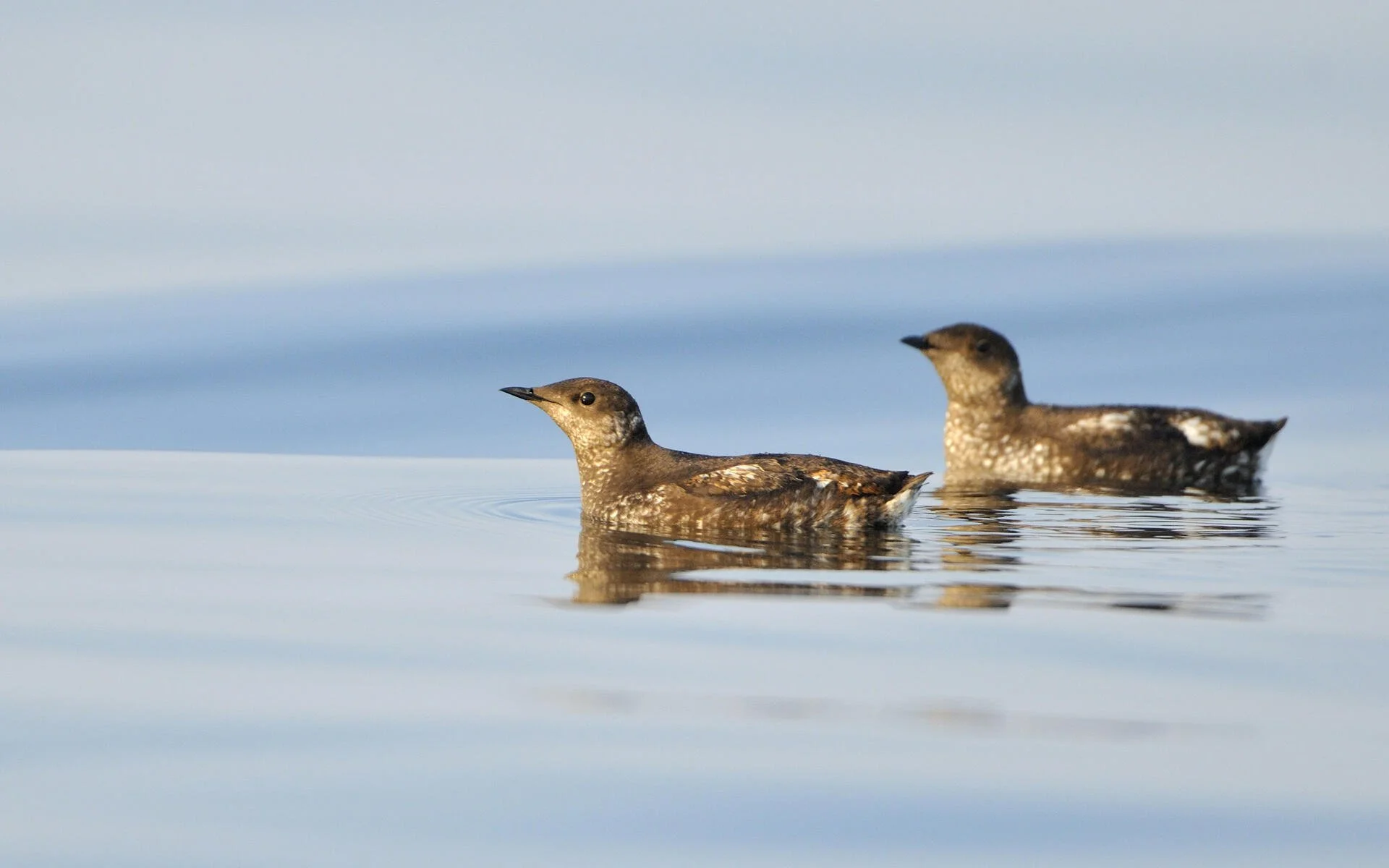
The Marbled Murrelet is a small, federally threatened seabird with a remarkable life cycle. Unlike most seabirds, it nests high in old-growth forests miles inland from their at-sea foraging areas, relying on both ancient forests and healthy coastal waters to survive. Unfortunately, the marbled murrelet population in Washington is low and declining and is now listed as “endangered” by the state. Because of its breeding association with old forests, their populations have been severely affected by loss of mature and old forest habitat. Food resources in the marine environment also influence its population status. Even where numerous, it is usually seen on the water in pairs or aggregations of pairs, not in large flocks. In front of an approaching boat, murrelets will either fly away low with very rapid wingbeats or dive, being very adept underwater swimmers.
Physical description
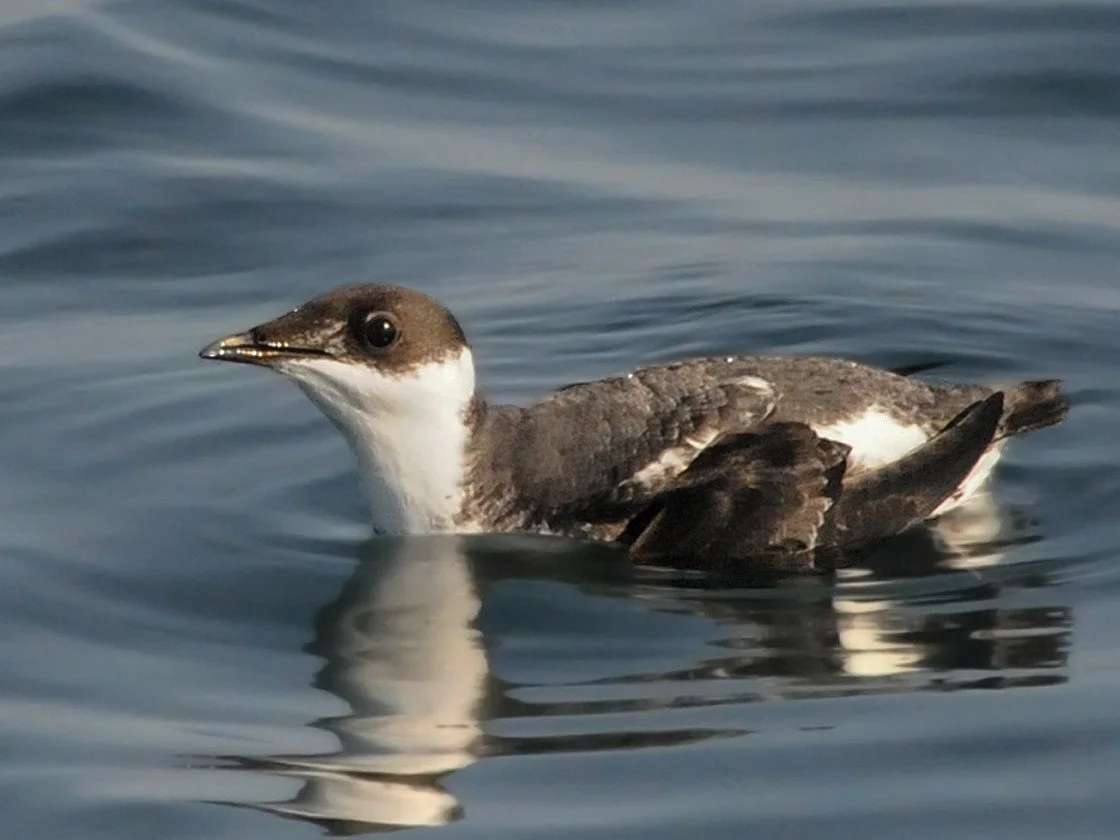
The marbled murrelet is a small (10 inches in length), chunky seabird. Its beak is black and slender. Breeding plumage has an overall brownish ‘marbled’ look. Adult non-breeding plumage is a black crown with a white ear patch, throat and underside, black nape and back, and black wings with white scapulars (top of wing). Juvenile plumage is similar to adult non-breeding but duskier overall.
Ecology and life history
Marbled murrelets locate their nest in a depression on a mat of moss, lichen or debris accumulations on large branches in mature and old-growth conifer forests. Marbled murrelets appear to establish long-term pair bonds and fidelity to nesting areas and nest trees. Small schooling fish (such as Pacific anchovy, Pacific herring, candlefish, and Pacific sand lance) make up most of the diet, which may include small crustaceans when fish are not abundant. Marine foraging areas are usually within 1.2 to 3 miles of shore but can be multiples more distant and typically in waters less than 100 feet deep.
Geographic range
The marbled murrelet inhabits the nearshore marine environment in western North America from Alaska to California. The Washington population is found in marine waters in general proximity to nesting habitat, but often involve lengthy flights between foraging and nesting sites to incubate and provision their nestling. It is most abundant in northern Puget Sound and the Strait of Juan de Fuca, and least abundant along the coast of southwestern Washington. The primary factor influencing breeding distribution is likely the availability of suitable nesting "platforms" (such as large branches) within functional proximity to marine water foraging areas.
Population Status
Surveys indicate highest nesting presence is on the Olympic Peninsula, the northern Cascades and in limited remaining habitat in southwest Washington. At-sea population monitoring from 2001 to 2015 indicated a 4.4% decline in the murrelet population annually, which at that time represented a 44% reduction since 2001. Since 1993 nesting habitat losses due to timber harvest in Washington have been substantial and at-sea population monitoring from 2001 to 2024 indicated nearly a nearly 5.0% decline in the murrelet population annually.
Sustained low juvenile recruitment (number of newly added adults to the population) has been identified as a main cause of their decline, but research to better understand the cause(s) is ongoing. Vital demographic data are lacking, and nest success is influenced by both terrestrial and marine factors, such as the availability of nesting sites, amount of nesting habitat, nest predation risks, and prey availability and quality. Declines in populations of forage fish species resulted in an increased consumption of lower trophic level food sources (invertebrates), which can require greater energy to capture and can be less nutritious.
Marbled murrelets continue to experience significant population declines across much of their range, with the steepest long-term declines in Washington. Their low reproductive rate means that high survival rates for young are essential for population growth.
While there may be “no definitive explanation” for the decline in Washington, the correlation of years of military jet activity with the coincident decline of murrelets, while sub populations to the south are increasing, strongly points to a potential Navy jet link. Without effective, immediate solutions to address these pressing threats, the situation for marbled murrelets is likely to deteriorate, and the species could be lost from some regions in the coming decades.
What is COER doing to protect the Marbled Murrelet from Growler noise?
In COER’s review of the expanded Growler Environmental Impact Statement and its accompanying Biological Opinion, it became clear that the Navy and U.S. Fish and Wildlife Service had not counted all the noise harassing exposures that marbled murrelets endure annually. Of particular concern are the exposures occurring during nesting. A frightening noise can make a provisioning adult drop the fish it was about to deliver to its chick or could cause the chick to fall from its nest. Noise harassment could also cause the fish-delivering adult to abandon the nest. In fact, Washington’s murrelets have a successful nest-to-sea recruitment rate far below that of Oregon and California where the Growlers are not harassing the nesting areas. If successful, COER’s lawsuit would force the Navy and USFWS to count all the exposures and then analyze the impact of that expanded number on the survival impact on the species.
Sources:
COER https://citizensofebeysreserve.com/lawsuits/
WDFW https://wdfw.wa.gov/sites/default/files/publications/02627/draft_wdfw02627.pdf
Audobon Society https://www.audubon.org/field-guide/bird/marbled-murrelet
The Salish Sea School https://www.thesalishseaschool.org/copy-of-research